University of Sydney · Team process design project · 2025
Role: Team Leader · Storage and BOG design · HAZOP · Overall P&ID
Tools: Microsoft Project · Microsoft Excel · Microsoft Visio
The team’s product stream table recorded approximately 56 tonnes per hour of liquid ammonia product. Calculating from the fresh-hydrogen feed and final ammonia-product molar flows gives an overall ammonia yield of approximately 99.4%, relative to the stoichiometric ammonia output available from fresh hydrogen. This provides a defined measure of the overall process yield from the team’s model data.
As Team Leader, I used Microsoft Project to prepare the Gantt chart and organise the project schedule. I mapped task durations, dependencies and planned milestones from 4 August to 7 November 2025, covering process selection, process design, individual unit design, review and optimisation, and the final presentation.
The team’s process review examined the relationship between nitrogen purity, throughput and energy use. Its DC-101 reflux-ratio study identified a minimum of approximately 1.2 and discussed a range of 1.2–1.7 for balancing these requirements. At fixed air feed and compressor power, increasing reflux improved nitrogen purity while reducing throughput and increasing energy cost per unit of nitrogen. This made reflux ratio an operating choice governed by product-quality and production requirements.
My individual engineering design focused on liquid ammonia storage and boil-off gas (BOG) handling. Using the product-stream basis of approximately 56 tonnes per hour adopted in that design, I calculated a required inventory of approximately 18,800 tonnes for 14 days of production. With the project stream density of approximately 680.5 kg/m³, this corresponded to approximately 27,700 m³ of liquid volume, establishing the basis for preliminary tank sizing.
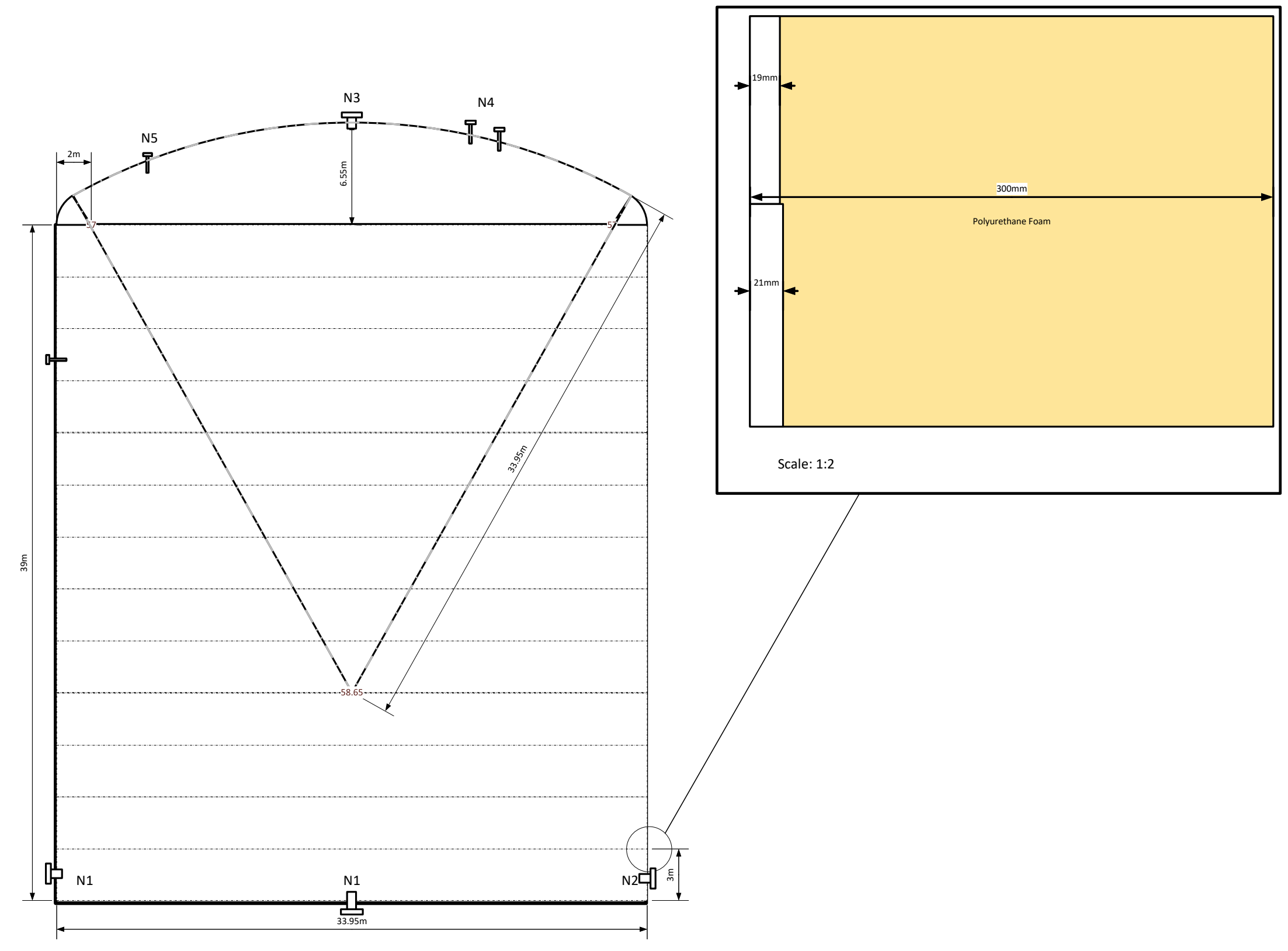
I used Excel to develop the inventory, geometry, shell-thickness and thermal calculations. Tank sizing used assumed fill fraction and freeboard, while shell thickness was estimated by horizontal course to account for the changing liquid head. The storage design adopted −33°C, a nominal pressure of 1.1 bar absolute and an ambient-temperature assumption of 40°C. I calculated heat inputs through the sidewall, roof and base, including the sensible heat brought in by incoming liquid, then used an energy balance to estimate BOG flow.
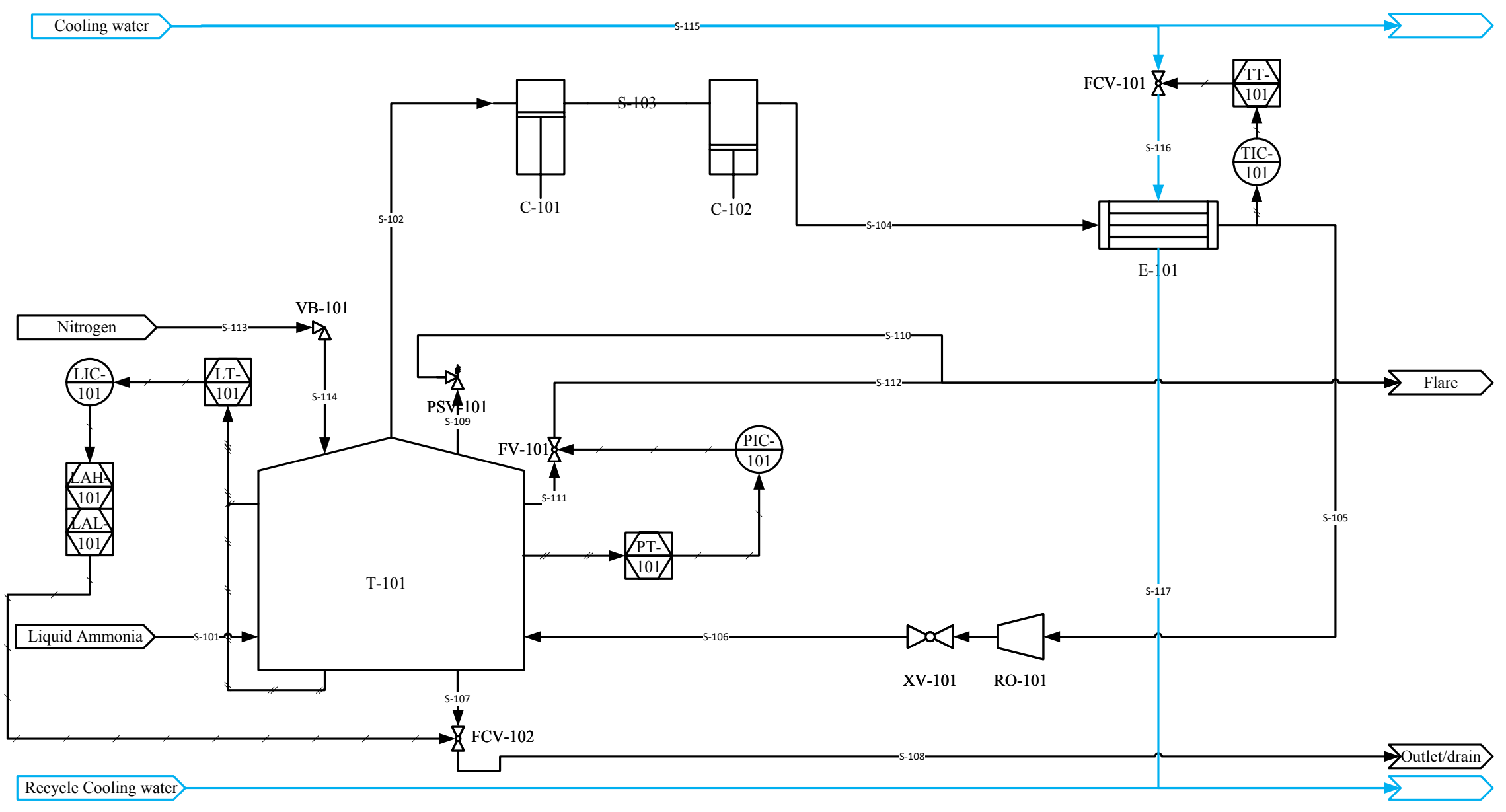
I carried that estimate into preliminary compressor, condenser and cooling-water calculations. I also worked through piping, valve and outlet-fitting calculations, including a bell mouth and anti-vortex plate, and documented the proposed pressure and level controls. This connected the storage requirement to its auxiliary equipment and control arrangements.
In the team’s HAZOP — hazard and operability — study, I organised and reviewed the minutes. For the DC-101 nitrogen-separation column, I chaired the reflux-inlet node discussion and served as secretary for the pressure-relief node. I also served as secretary for the whole-plant HAZOP discussion. The record assigned nine follow-up items to me, covering instrumentation and controls, utility provisions, isolation and waste handling.
I used Microsoft Visio to prepare the individual storage and BOG P&ID and produced tank drawings, an equipment specification and the individual design report. At plant level, I drew and revised the overall P&ID, integrating feed preparation, nitrogen separation, ammonia synthesis, product recovery, storage and their control connections into one diagram. The drawing records an initial version on 31 October 2025 and my revision following internal review and HAZOP on 4 November.