University of Sydney · Design A team project · 2025
Tools: Microsoft Visio · Microsoft Excel · Microsoft PowerPoint
I collaborated on process selection, mass balances, equipment design, HAZOP and economic analysis. We used Excel to build the calculation models, Visio to develop process and control drawings, and PowerPoint to present the design, its basis and the key findings.
On a model basis of 8,000 operating hours per year, the team’s design produced a calculated API product output of approximately 2,547 tonnes per year at 99.93% mass purity, meeting the 2,500-tonne annual target. The overall molar yield was approximately 56.59% relative to fresh phenol feed. At 500 mg of API per tablet, the tablet production target corresponded to approximately 250 tonnes of API in the finished tablets annually, with the remaining design capacity allocated to bulk API sales.
After comparing synthesis routes, we selected phenol as the starting material and organised the process into intermediate production, API synthesis and purification, and tableting and packaging. Our Excel balances connected reactions, separations and recycle streams to calculate unit throughput, product recovery and utility requirements. We also used the material, equipment and operating requirements to develop cost estimates.
My specific drawing work included the initial equipment and process diagrams for intermediate production and API synthesis, together with the initial process-control drawing for intermediate production. I used Visio to document equipment, streams, recycle paths and control connections, then worked with my teammates as the design developed. The revision records identify my initial process drawings in March 2025 and the initial controls in April.
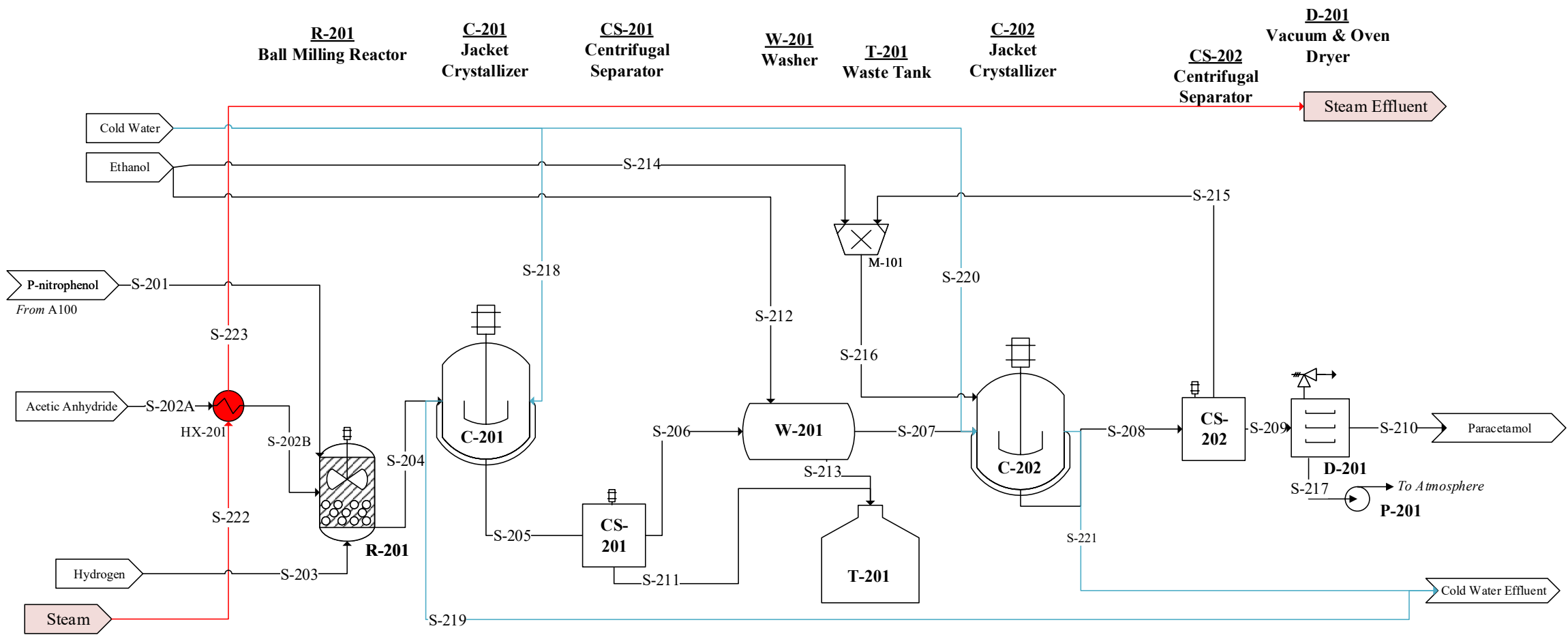
For the HAZOP review of the p-nitrophenol acetylation and hydrogenation reactor, I served as the process expert. I contributed to the review of the feed conveyor and ball-mill reactor, examining flow, temperature, pressure, level and catalyst deviations and connecting the discussion to instrumentation, alarms and protective measures.
For the detailed nitrophenol steam-separation column design, I worked with the team to translate the separation of o-nitrophenol and p-nitrophenol into gas and liquid flows, packing requirements and vessel dimensions. In this unit’s detailed-design model, more than 99.9% of the o-nitrophenol entered the overhead vapour stream, while the loss of the desired p-nitrophenol intermediate was approximately 0.34%. The corresponding preliminary equipment design used an internal diameter of approximately 1.0 metre and a packed height of 2.11 metres.
We brought the Excel calculations, Visio drawings, HAZOP, equipment specifications and economic assessment together in the final team report, and used PowerPoint to present the design from production targets through to process, equipment and controls.